Your brand is not yet a
must-have.
But it can be.
For nearly thirty years, I've used FOMO to help CEOs build
brands customers cannot live without. This book is the
methodology. In print for the first time.
Instant download. The eBook and Implementation Guide.
Both for $14.99 · special introductory rate.
FOMO is bigger than you think. Much bigger.
It's the operating system our customers run on, all the time. Seventy to ninety percent of them.
Not the "countdown timer" version. The foundational version, where every purchase is shaped
by the fear of missing the life we want, the person we're trying to become, that's slipping away.
That is a business opportunity of extraordinary scale.
Marketers have been handed a version of FOMO that captures maybe ten percent of what it
makes possible. When the subject comes up in a strategy session, someone reaches for what I
call "FOMO Activators". Scarcity. Urgency. "Only 2 left at this price." Not wrong. But fatally limited.
Activators only work on customers who already want the product.
You can't activate a desire that doesn't exist. A countdown timer for something you don't care
about is wallpaper. Expensive wallpaper.
On the other hand, "FOMO Generators" inflame the desire that drives high pricing, defeat
comparison shopping, and make customers afraid to leave.
A FOMO Generator is a strategic positioning that makes your brand feel essential to who your
customer is becoming. Not a tactic for the bottom of the funnel.
The foundation everything else is built on.
Generators first. Activators second. Most brands have it exactly backwards.
Activator tactics are everywhere. The Generator methodology is in this book. The full version.
Most desires are negotiable.
Customers want plenty of things they can defer. Trade down on. Quietly abandon when something easier comes along. They see an ad, feel something, scroll on. They compare you to three competitors, pick the cheaper one, feel fine about it.
This is ordinary desire. And ordinary desire produces ordinary brands. Preference without loyalty. Market share without moat.
Super motivations are different. They're desires so personally essential and fused with FOMO that failing to act on them doesn't feel like a missed purchase. It feels like a missed life.
Customers don't comparison-shop their way to super motivations. They don't negotiate. They pay Eight Sleep two thousand dollars for a mattress cover. They stand outside Target at 5:47 AM in line for a limited-edition water bottle.
Not irrationally. Because the brand made itself essential to the version of themselves they're building.
Walking away doesn't feel like switching products. It feels like giving up on that.
That's the difference between a brand people prefer and a brand people crave.
Super motivations can be tied to any category. Including the practical ones, where everyone assumes psychology doesn't apply. Slack. Liquid Death. Who Gives a Crap. Each identified a super motivation nobody else was speaking to. And when desire shifts from ordinary to vital, the customer stops behaving like a customer. They behave like a believer.
That shift is engineerable. Customers move from fearing they'll miss a vital desired state in life, to fearing they'll miss your brand, the one that gets them there. The brand becomes the object of FOMO itself.
This is what the FOMO-Flip Method does. New brands enter markets as immediate must-haves. Existing brands stop being options and become necessities.
The moment it clicks, it doesn't unclick.
You start to understand differently, customer statements that you were always hearing but never decoding. They become coordinates. Every one of them points directly at the super motivation worth building around.
Once you can read them, you can't stop reading them.
The shift isn't just a technique you apply. It's a lens you can't take off.
Your competitors find you baffling.
Good. That's the position
Inside the book
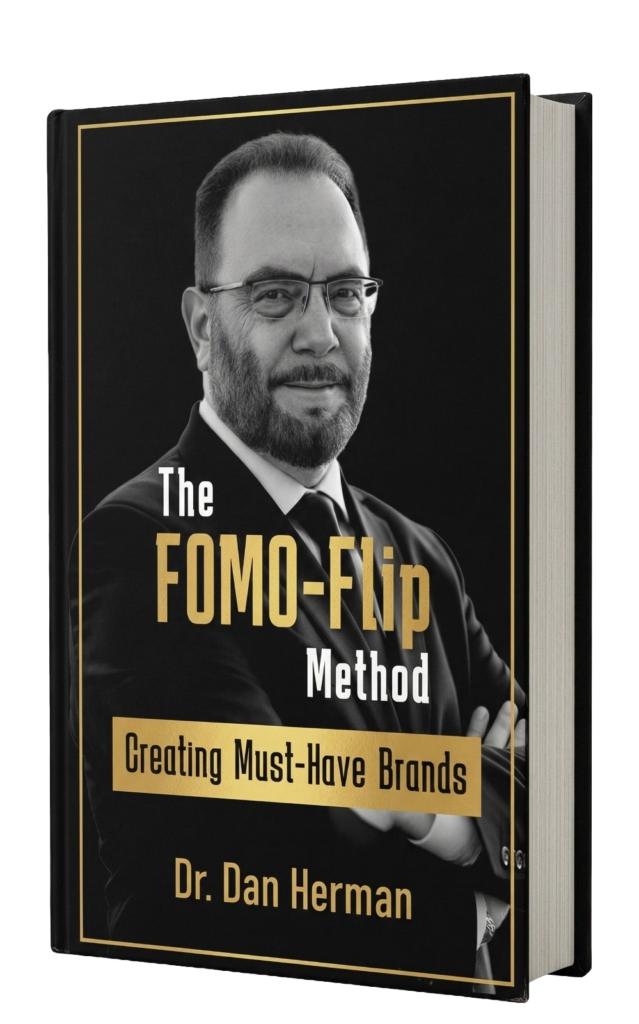
THE FOMO-FLIP METHOD: Creating Must-Have Brands
Thirteen chapters. Three acts. Every chapter includes at least one proprietary tool built for actual strategy sessions, not post-read reflection.
Act One
FOMO isn't a social media trend or a Gen Z problem. It's the operating principle behind why markets move the way they move, why huge trends and new markets emerged, and why loyalty has collapsed across industries.
We build the psychological foundation: the anatomy of desire, the four life pursuits that organize everything your customers want, and the ten FOMO-generated motivations reshaping consumer behavior right now.
One of those deserves its own sentence. The Success Paradox: why high achievers carry more FOMO than anyone, not less. Achievement doesn't close the gap. It widens it. By the end of Act One, you'll look at some of your most successful competitors' moves and think: now I see what they were doing.
Act Two
Four stages from diagnosis to unmissable positioning. The first two are diagnostic: finding the vital desire gap, the space between who your customers are and who they urgently need to become, and locking onto the super motivation that charges it. The third is where the methodology earns its name. The FOMO-Flip: the precise moment the brand stops being an option and starts being something customers are afraid to miss. The fourth is the promise that makes it permanent.
Two chapters deserve special attention. The brand-added value chapter explains how premium pricing power actually works, including why Coca-Cola wins a branded taste test and loses a blind one. The messaging chapter maps the three psychological starting points your customers actually occupy when they encounter you, and why sending the right message to the wrong starting point costs more than saying nothing.
Act Three
Act Three is what most books skip. Think-Short Branding for brands built on a deadline, because some of the highest-margin work in this discipline happens in compressed timeframes with a completely different toolkit. Then the chapter nobody wants to admit applies to them: how FOMO quietly infiltrates the strategists themselves, inverting the Generator-Activator sequence until the whole thing collapses from the inside. And the thirty-day bridge between knowing and doing. Because smart people read smart books and change nothing. That gap has a structure, and this chapter addresses it directly.
Also included: The FOMO-Flip Implementation Guide
The book describes the methodology. The Guide lets you use it.
The Before-After Analysis Template
The FOMO-Driven Customer Profile Template
The Brand Promise Formula
The Desire Gap Mapping Exercise
The Brand-Added Value Audit
The Super Motivation Diagnostic
Each tool is explained in the book. In the Guide, it's an instrument you fill in.
Instant download. The eBook and Implementation Guide.
Both for $14.99 · special introductory rate.
CEOs call me when something big is on the table
A goal that sounds almost like a wish. A major move where getting it wrong isn't an option. A competitive threat the usual approaches won't touch.
I consult mostly with CEOs of privately owned companies worldwide.
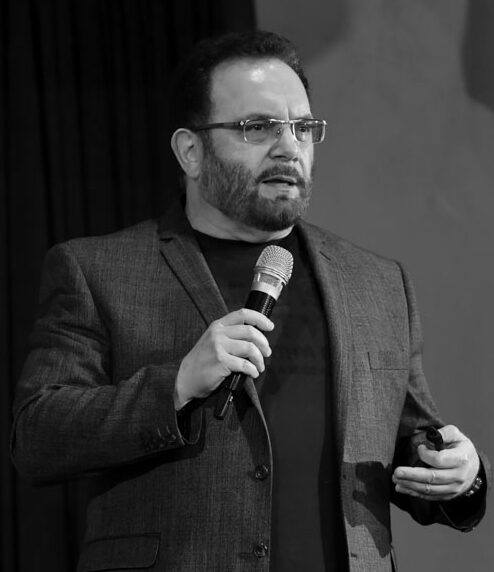
My work is at the intersection of psychology and business. Before going independent, I was a CEO, deputy CEO, and VP of Marketing. I sat in the chair you're sitting in. I know what it means to carry the outcome, not just the opinion. That's a different thing entirely.
In 1996, midway through client research, I discovered FOMO. Not as a researcher hunting for interesting phenomena. As a practitioner who found a mechanism that explained what I was seeing in real markets. The three decades since: developing and refining the methodology, applying it with clients across industries and continents.
This is not theory from the outside. It's the methodology I've been using with clients for thirty years, in print for the first time
ABOUT ME
What CEOs say
"Dr. Dan Herman's insights are fascinating, and the solutions are original and practical."
Idan Ofer
Chairman, Israel Corp.
"A league of his own. In a quick and very purposeful process, we built a differentiated concept and business model that paved the way for success."
Yakir Zaken
CEO, Safra College
"The short process we did with Dr. Dan Herman led to a new strategy we hadn't even considered."
Yinon Sherez
CEO, Argentools Group
"Much more than a consultant. He is definitely the partner every CEO wants by their side."
Dr. Amira Paz
CEO, Healthy Aging
Questions
The psychology doesn't negotiate with headcount. I've run this methodology with global corporations and with companies of twelve people. Consumer products. B2B services. Categories where everyone said differentiation was impossible, and premium markets where everyone said the pricing was unjustifiable.
The one constant in all of it: customers who were human beings afraid of missing the life they wanted.
That bar doesn't check your revenue before it applies.
Every B2B purchase is made by a human being. That human being has super motivations, whether they're buying enterprise software or a logistics contract.
"I need to look like a strategic decision-maker in front of the board" is a super motivation. It just doesn't usually make it into the RFP.
The desire gap doesn't care whether it's sitting in a consumer's cart or a procurement officer's spreadsheet. It works the same way in both. The book has B2B examples throughout, because the translation isn't obvious and getting it wrong is expensive.
Much of it, immediately. The final chapter is a thirty-day sequence. One week of observation and profiling. One week of FOMO-Flip analysis. One week of brand promise formulation, including a single well-placed test connected to super motivation rather than ordinary desire. A final week of storytelling and messaging.
The room stops arguing after that.
Every month without understanding your customers' super motivations is a month competing in the wrong game. You're optimizing preference in a market where preference has become disposable.
Every competitor who absorbs this while you're still working with ordinary desire is already playing for psychological necessity.
You're playing for preference. They're playing for necessity. Those aren't two competitive positions. They're two different industries.
.Stop competing for preference
.Start becoming necessary
Instant download. The eBook and Implementation Guide.
Both for $14.99 · special introductory rate.